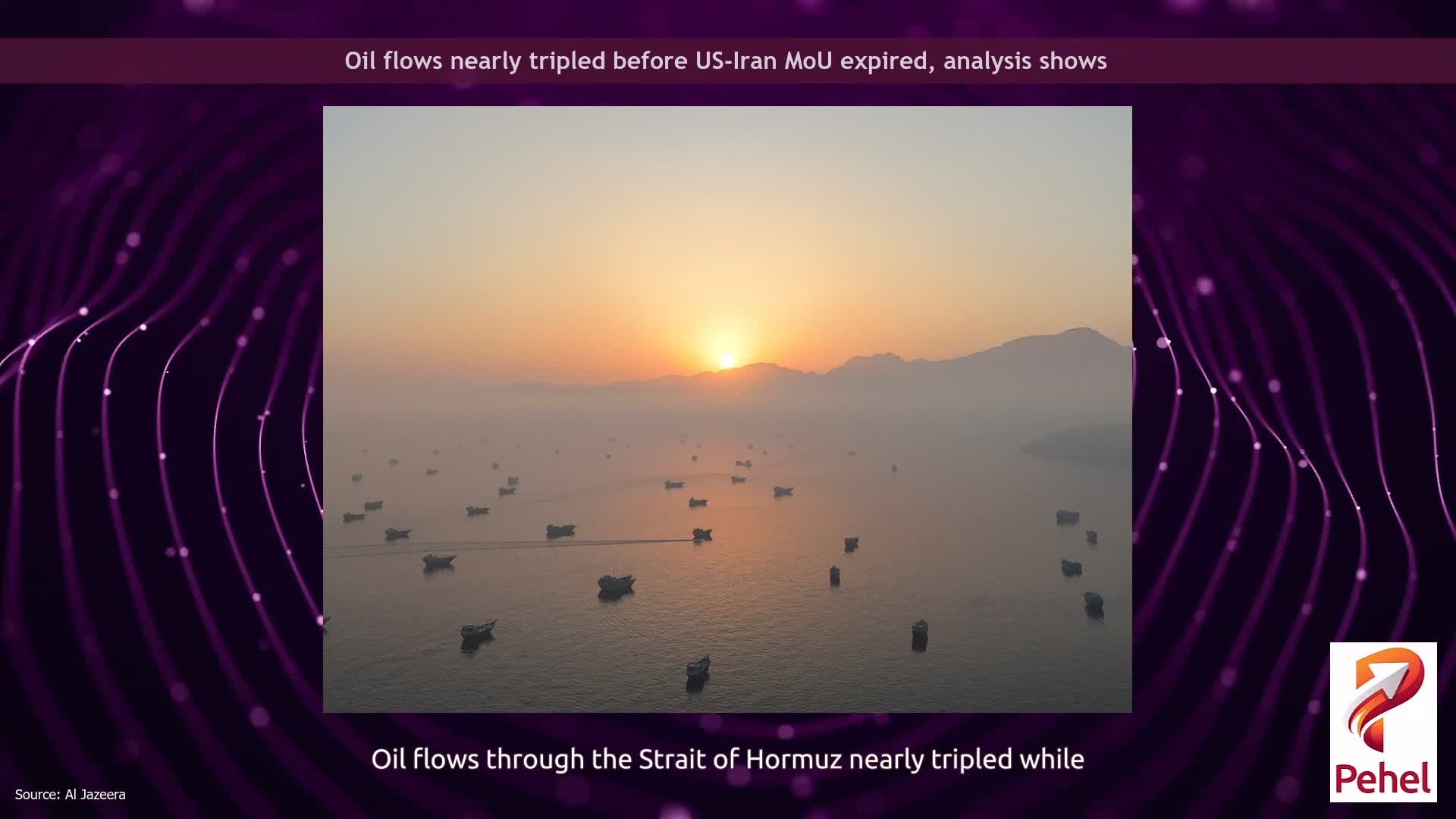
The world lost more than 2.6 billion barrels of oil since the US-Israel war with Iran began late February, yet oil market prices have not gone berserk. Except for one occasion, it has stayed away from touching the three digit/barrel prices.
Last week, the head of Saudi oil giant Aramco, Amin Nasser, warned that global inventories were running low despite emergency measures to cushion the blow. The lost supply is equivalent to nearly a month of normal global crude production, underscoring the scale of a disruption that has closed the major oil chokepoint, the Strait of Hormuz, upending energy markets.
During the entire period, crude oil prices have mostly continued to be in two digits, defying some projections that, in case the Strait of Hormuz stays blocked for long, oil markets could touch or even go above the $200 per barrel mark, bypassing in the process the peak of $147 per barrel touched in the summer of 2008.
What has kept the oil markets under some check despite all the upheaval?
EVs displaced 1.4m barrels of oil a day during the first half of 2026 in China, the world’s largest crude oil importer
Analysts are of the view that timely strategic reserve releases by the Organisation for Economic Co-operation and Development countries, lower Asian demand, and China’s sharp reduction in crude imports helped markets avoid extreme spikes despite five months of disruption due to the war in and around the Strait of Hormuz.
The China factor has played a significant role in keeping the markets on a leash. The biggest cushion the market has had was China’s crude oil import behaviour, says Tsvetana Paraskova writing for Oilprice.com. China has played a significant role in limiting market swings during the crisis. As the global swing consumer, China has also seen the crisis help solidify its status as the mover and shaker in the global energy world.
By reducing its consumption and crude oil imports, China, the world’s largest crude oil importer, has helped ease and stabilise the oil markets from wild swings.
Several factors have helped China keep its oil imports under a tab. The ongoing electric vehicle (EV) boom in China has been a major factor helping China reshape global oil demand. It is contributing to global demand destruction.
Investment bank and financial services company Jefferies has reported that EVs displaced an estimated 1.4m barrels of oil a day (bpd) in China during the first half of 2026. Citing research by the Centre for Research on Energy and Clean Air (CREA), Jefferies estimated that electric vehicles displaced 33.7m tonnes of oil equivalent (Mtoe) in the first half of 2026. This transition is steadily reducing the country’s dependence on crude oil, the report highlighted.
The pace of the transition is remarkable. The report notes that oil displaced by EVs has almost tripled in just three years. During the first half of 2023, electric vehicles displaced 11.6m tonnes of oil equivalent, or roughly 0.5m bpd. By the first half of 2026, that figure had climbed to 33.7 million tonnes, or 1.4 million bpd.
Interestingly, new electric vehicles accounted for a record 63pc of all passenger vehicle sales in June 2026, up sharply from 33pc in January 2024. In practical terms, nearly two out of every three new passenger vehicles sold in China are now electric or plug-in hybrid models.
Jefferies’ projections are not far from those of the International Energy Agency (IEA). The IEA estimates that EVs displaced around 1m barrels of oil demand per day in China during 2025. It expects that number to increase to 2.7m barrels per day by 2030, as EV adoption continues to accelerate across the country.
The trend is not limited to China. The crisis has helped fuel a transition to EVs virtually all around. Citing an International Energy Agency report, Suvrat Kothari said in a piece that high gas prices due to the war in Iran drove record sales of electric and plug-in hybrid electric vehicles (PHEVs) in a whopping 50 countries in the second quarter of this year.
The US-led war in Iran triggered an acute oil shock accelerating the adoption of EVs and PHEVs around the world, the IEA says. While EV sales in the US have declined year-over-year, the demand for plug-in vehicles is booming in other parts of the world, the IEA added in its latest report.
The IEA reported that dozens of countries across Southeast Asia, Africa and Latin America have either expanded existing incentives or introduced new ones since the war began to boost electrification. Plug-in vehicle sales in Australia, India, Brazil, South Korea and Vietnam doubled between March and June compared to the same period last year, according to the IEA.
Automakers sold more than 9m electric and plug-in hybrid cars globally in the first half of this year, including more than 5m in the second quarter alone. Interestingly, this happened while overall vehicle sales faced a downturn. Recent reports indicate that Pakistan is also striving to take a plunge into the electric vehicle era. Yet, to be fair, we are still slow and far behind most.
China also helped control the markets by keeping its crude oil purchases low and using its strategic reserves to meet its demands. Before the war, China was buying more barrels than the entire European continent and almost twice as much as the second-largest importer, the United States.
Then, weeks after the conflict broke out, the country abruptly slashed its oil purchases, eventually cutting its imports by half compared with prewar levels. That appears to be why global prices have risen so much less than experts predicted, said Rogé Karma writing for The Atlantic.
Monthly data from China’s General Administration of Customs indicate that China imported just 8.1m bpd of crude oil in 2Q26, 32pc less than the previous quarter. In May and June, imports fell below 8m bpd for the first time since 2016.
The ongoing crisis in the Middle East has altered the global energy landscape in more than one way. It has helped spur the adoption of electric vehicles. Most importantly, it has helped China galvanise its position not only as the world’s sole swing consumer but also as a trend setter in the real sense.
The writer is an energy analyst and has delivered talks at the Department of Energy in Washington and the International Energy Agency. X: @rhusainsyed
Published in Dawn, The Business and Finance Weekly, August 10th, 2026