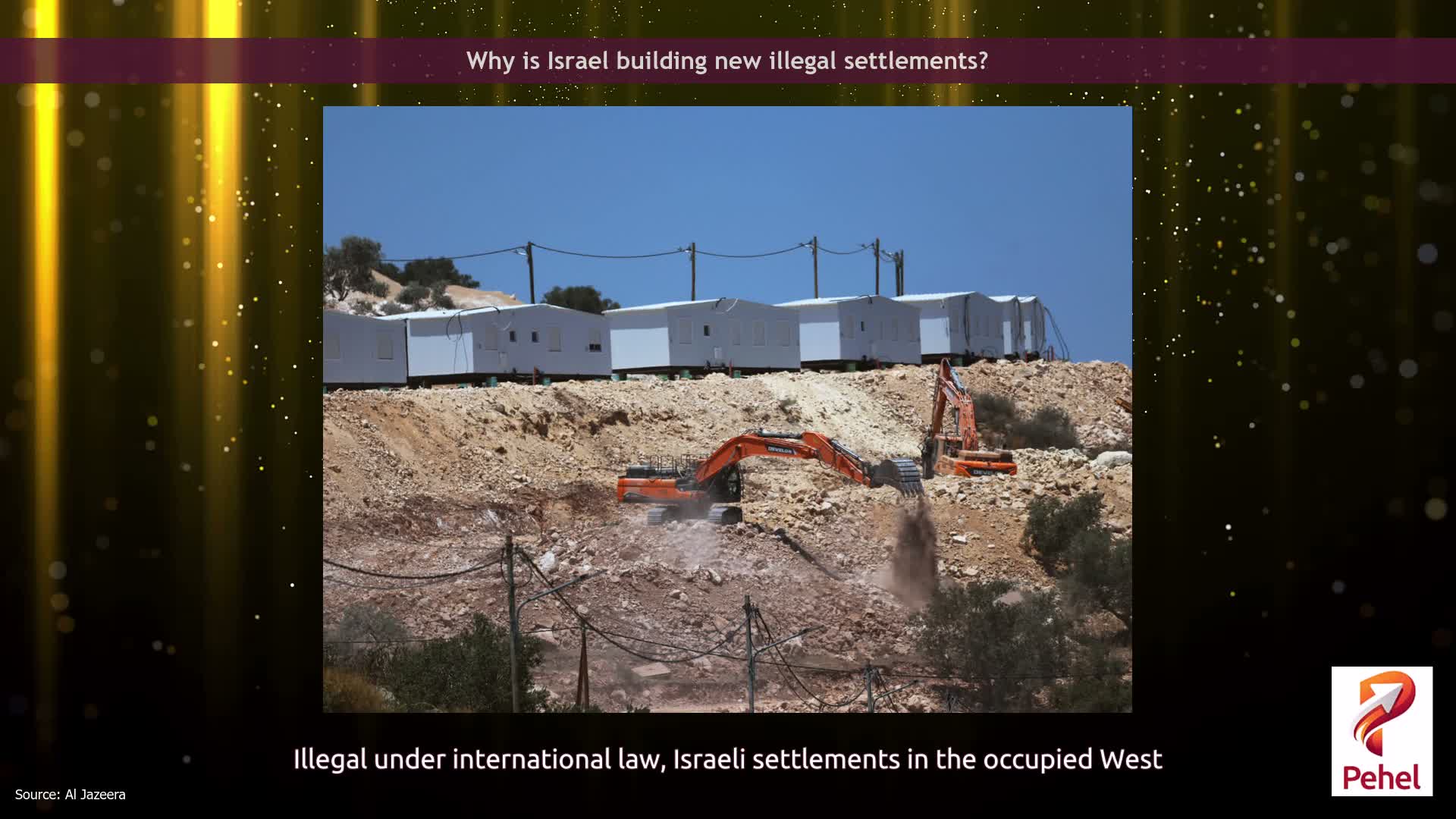
As Israel gears up to hold elections in October, a dramatic surge in settlement activity has heightened concerns that the settler movement is stepping up efforts to cement its grip on the occupied West Bank, in stark defiance of international law.
Last week, the United Nations warned that attacks by Israeli settlers – often carried out alongside Israeli forces – and the creation of illegal settlements and outposts had hit “an all-time high”.
The uptick comes as members of Israel’s hard right seek to ratchet up the political temperature ahead of the crucial polls. It also follows a parliamentary term during which Israel moved to entrench control over the West Bank deeper within the machinery of the state, shifting authority from military administration to civilian institutions, accelerating settlement planning and expanding infrastructure.
However, the Religious Zionist Party of Finance Minister Bezalel Smotrich – the man widely credited as pushing the settler project to the forefront of Israeli political debate – is suggested by numerous opinion polls to be far from certain to even meet the electoral threshold for the post-election Knesset.
This has prompted what analysts describe as a desperate scramble to promote the settlement mission while consolidating the support of the settler minority that Smotrich grew up within.
Speaking at a meeting of Prime Minister Benjamin Netanyahu’s right-wing Likud Party in late July, Israel’s Defence Minister Israel Katz boasted that, under the governing coalition and Smotrich’s supervision, Israel had approved the establishment of 104 illegal settlements and some 160 settlement farms in the West Bank since coming to power in 2022, according to Israeli media.
In August of last year, Smotrich announced the creation of the E1 settlement project , linking occupied East Jerusalem with the existing settlement of Maale Adumim, located several kilometres to the east – a proposal which, Smotrich bragged, “buries the idea of a Palestinian state”.
Smotrich, who made increased administrative control over the West Bank a condition for supporting Netanyahu’s right-wing coalition in 2022, has undertaken a series of measures to expand the influence of settlers within policymaking.
In 2023, he established his influential Settlements Administration agency within the Ministry of Defence – which oversees the West Bank’s occupation. And last month, he legally embedded the agency within the ministry, making it harder to reverse any of the decisions taken under its watch.
Israeli political analyst Nimrod Flaschenberg said it is “hard to imagine” that Netanyahu “won’t come up with some kind of imaginative ploy to keep him and the far right on the ticket”, referring to Smotrich.
“He has very strong support within the settlements and the ideological far-right,” Flaschenberg added, “but that might not be enough in and of itself to get him securely past the threshold. He’s being squeezed between the populism of [far-right Israeli National Security Minister Itamar] Ben-Gvir and what many people in the lower middle class see as the security of Netanyahu.”
Allied to Smotrich is a prime minister who observers describe as facing not simply an electoral battle, but an existential battle for both his freedom – as a consequence of his long-running corruption trial – and legacy, should the independent inquiry into his failings ahead of the Hamas-led attack of 2023 go ahead.
Given the stakes, some analysts have suggested the incumbent was far from ready to gamble on losing the support of Israel’s hard right and settler movement by condemning the increasing levels of violence in the West Bank.
“We saw him come out on US TV and concede that there may have been a few incidents in the West Bank, but nothing serious,” Chatham House’s Yossi Mekelberg said of Netanyahu’s response to the widespread violence that has swept the West Bank in recent weeks.
“He needs the hard right and settlers’ support, if not for him individually, then at least for his bloc.”
While Netanyahu may feel he has room to manoeuvre over the hugely controversial issue of ultra-Orthodox conscription, no such margin existed within the hard right and settlers. Ultra-Orthodox parties, a key component in the 2022 coalition government, have made the exemption of their constituents from the draft – which almost all Israeli adults are eligible for – a pillar of their political campaigning in recent years.
“Netanyahu knows that the ultra-Orthodox will likely stay with him,” added Mekelberg. “The settlers are more binary. You’re either for them or against,” he said.
Irrespective of electoral tactics, the consequences for people living in the occupied West Bank have been catastrophic. In July alone, according to the Palestinian Authority’s Colonization and Wall Resistance Commission, there were 2,256 attacks against Palestinians and their property: 1,458 by the Israeli army and 798 by settlers.
After Yair Golan, leader of the opposition Democrats party, offered a rare criticism of the settler “extremism” which triggered the latest round of violence, Katz accused him of spreading a “blood libel”.
According to leaks of the same meeting in Hebrew-language media, other ministers present called for a harsher response to any resistance from Palestinians, and for the military to be given even greater freedom to shoot at them.
“As the election gets closer, we’re seeing an even greater increase in the violence that’s been escalating ever since October 2023,” said Yair Dvir, of the Israeli rights group B’Tselem.
“It’s important to add this isn’t just the scale of the violence, but also its brutality and the participation of the Israeli state – both the soldiers and the political support they’re receiving.”