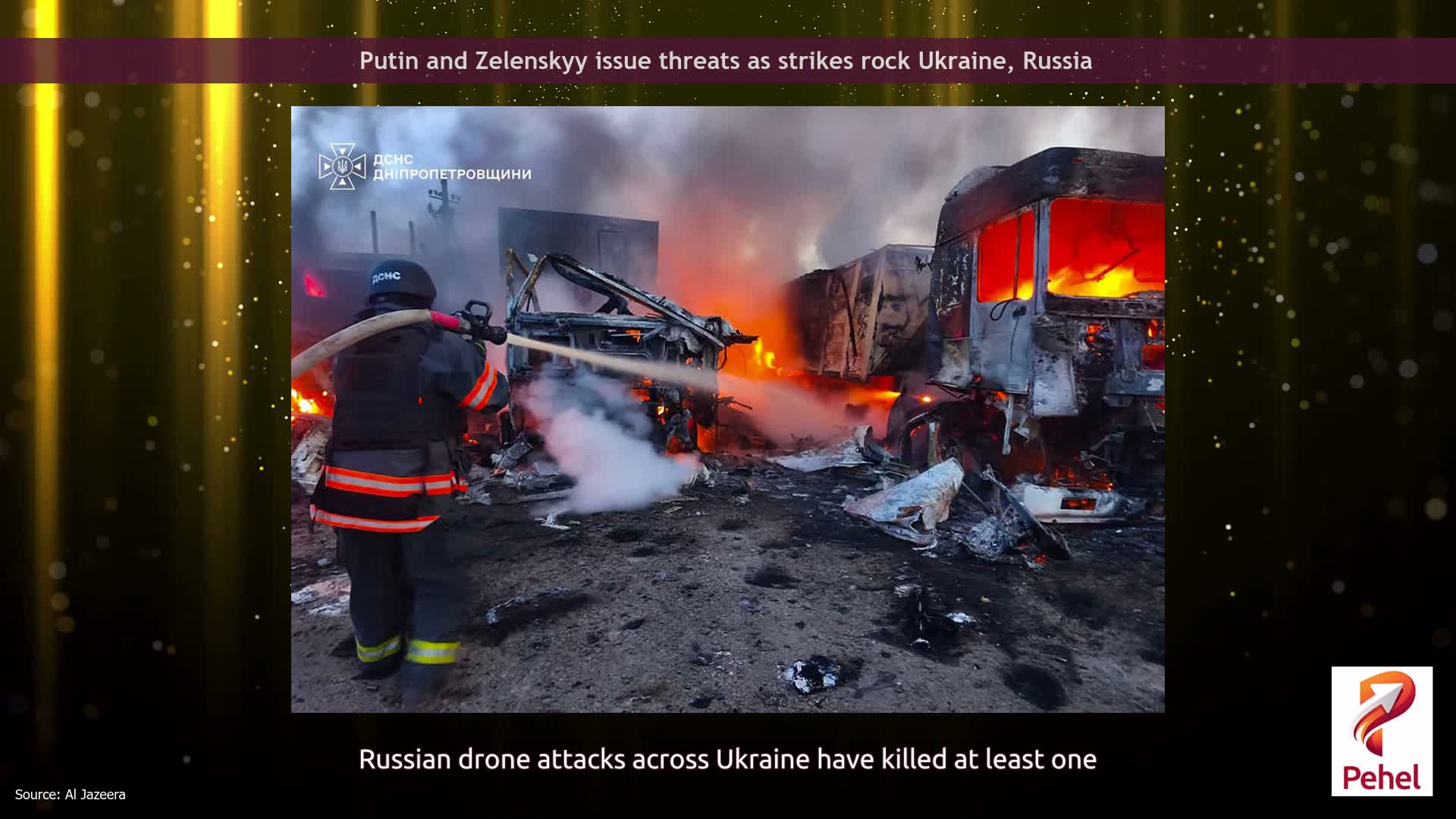
Fourteen people have been killed in Russian attacks across Ukraine overnight and on Wednesday, local officials say.
In the Black Sea port of Odesa, three people were killed in a "massive" drone and missile strike, regional head Oleh Kiper said. It was the fifth day in which Russia has hit the region.
Three people were killed the north-eastern city of Sumy, and another three in Zaporizhzhia in the south. Five casualties were also reported in three other south-eastern regions.
Ukraine said its drones hit 20 Russian vessels, including 17 oil tankers, in the Black Sea overnight.
Separately, a major government reshuffle is now under way in Ukraine, with the country's prime minister and defence minister both resigning.
Earlier, the Russian ministry of defence confirmed it had attacked Odesa, saying it had deliberately targeted port infrastructure, "used for the unloading of petroleum, oil, and lubricants".
Writing on Telegram, Kiper accused Russia of deliberately targeting the civilian population and said residents were killed and injured when a Russian missile struck a multi-storey residential building.
He added that a non-residential building and a gas pipeline were also hit.
In its report issued on Tuesday, the United Nations Human Rights Monitoring Mission in Ukraine said at least 293 civilians were killed and 1,990 injured in Ukraine in June.
It said that long-range weapons - such as missiles and drones - "remained the leading cause of civilian casualties", accounting for 45% of deaths.
"Most casualties from these weapons occurred far from the front line in urban centres such as Kyiv and Dnipro," the UN monitors said.
In its statement, Russia's military claimed to have targeted sites involved in the manufacture of military hardware, and the transport of cargo.
Russia's attacks in recent days have targeted Ukraine's deep-water Black Sea ports in the wider Odesa area, which handle much of the country's grain and other cargo and are vital to its wartime economy.
It follows intensive attacks on Russian ships in the Sea of Azov, which sits between the Moscow-annexed Crimea and Russia.
The Ukrainian attacks have forced Russia, the world's top grain exporter, to restrict shipping in the Sea of Azov - a route that handles about a quarter of its grain exports, according to news agency Reuters.
Meanwhile, Ukraine was attempting to navigate a tumultuous political situation which has seen President Volodymyr Zelensky dismissing Prime Minister Yulia Svyrydenko after less than a year in post.
A motion to accept Svyrydenko's resignation was passed in Ukraine's parliament on Tuesday, despite some lawmakers questioning whether the reason for the change had been explained.
Serhiy Koretskyi, the head of state oil and gas firm Naftogaz, is seen as a likely successor to Svyrydenko, with parliament set to vote on the appointment on Thursday.
On Wednesday, Defence Minister Mykhailo Fedorov - who is widely credited with transforming Ukraine's armed forces into a more efficient and deadly force - posted what appeared to be a resignation statement on social media.
"It was a great honour to serve the Ukrainian people as a defence minister," he wrote on Telegram late on Wednesday.
Some reports suggested he may be replaced by current Interior Minister Ihor Klymenko.
Zelensky has not publicly commented on the issue.
European Commission President Ursula von der Leyen had arrived in Kyiv early on Wednesday to discuss co-operation between European and Ukrainian defence industries, as well as Ukraine's accession path to the European Union.
Russian President Vladimir Putin launched a full-scale invasion of Ukraine in February 2022.