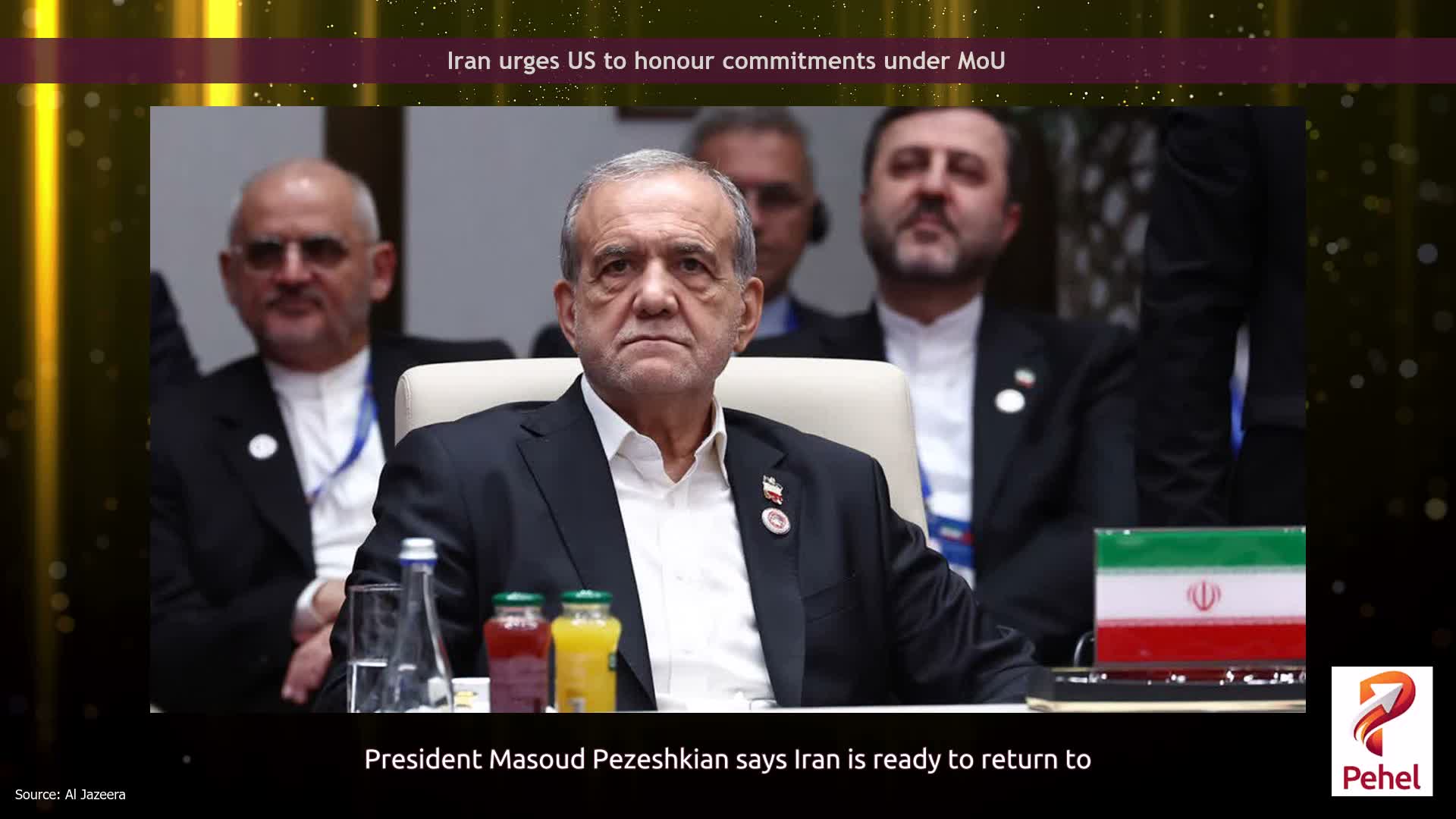
A memorandum of understanding (MOU) for ending the US-Iran war has been electronically signed near the French capital, Paris, after weeks of US President Donald Trump’s repeated claims that an agreement was close.
The 14-point framework signed on Wednesday sees Iran commit to refrain from procuring or developing nuclear weapons in exchange for sanctions relief, a $300bn reconstruction plan and the restarting of maritime traffic in the Strait of Hormuz.
In comments made on the sidelines of the G7 meeting in France on Wednesday, Trump hailed the deal with Iran as being better than the deal brokered by former US President Barack Obama in 2015, known as the Joint Comprehensive Plan of Action (JCPOA), which Trump withdrew from during his first term in 2018.
However, analysts warn it is too soon to determine whether the MOU, which triggers a 60-day negotiation period , will result in a comprehensive deal significantly different from the 18-page Obama-era document, which took several years to negotiate and included the input of nuclear experts.
Aniseh Bassiri Tabrizi, associate fellow at Chatham House, in the UK, told Al Jazeera it would not be “fair” to compare the two at this stage, as the MOU focuses on extending the ceasefire rather than tackling Iran’s nuclear programme in detail.
Shahram Akbarzadeh, director of the Middle East Studies Forum at Deakin University in Melbourne, Australia, said the MOU “does not address any issue of substance.” “It simply leaves all questions regarding Iran’s nuclear programme and enrichment to be negotiated between the United States and Iran,” he said.
Here’s how the little we do know about the agreement compares to the provisions of the JCPOA.
The agreement pushes discussions about Iran’s nuclear programme into the 60-day negotiation period, but states that Tehran “shall not procure or develop nuclear weapons”. Both sides also commit to “resolve the disposition of stockpiled enriched material pursuant to a mechanism that will be mutually agreed upon”.
The JCPOA included the same commitment not to develop nuclear weapons from Iran. It did allow Iran to enrich uranium up to 3.67 percent for 15 years – enough for developing a nuclear power programme, but well below the 90 percent needed to produce nuclear weapons. The memorandum does not mention whether Iran will be allowed to enrich uranium at all or for how long.
Up until Trump withdrew the US from the JCPOA, independent inspectors confirmed that Iran had stuck to the specified limits.
Akbarzadeh pointed out that the Iranian pledge not to develop nuclear weapons included in the MOU is “not a new point, or a new commitment”. “Iran has consistently reiterated that it does not pursue the atomic bomb,” the analyst said.
Additionally, while the JCPOA was an international agreement including China, Russia, the UK and Germany “with detailed measures to limit uranium enrichment and an intrusive monitoring regime to ensure Iranian compliance”, the memorandum is a shaky bilateral agreement between parties who have little trust in each other, Akbarzadeh said. While the JCPOA had very specific terms for sanctions in the event of non-compliance, no such details are in the memorandum.
The JCPOA did not place limits on Iran’s conventional military, including its supply of ballistic missiles – something that the US had demanded before the start of the war, but which is similarly not addressed by the MOU.
Frederic Schneider, non-resident senior fellow at the Middle East Council on Global Affairs, also noted that, in itself, Iran’s commitment to refrain from developing nuclear weapons was no significant gain for the US.
“A Trump deal achieving this would be merely preserving the status quo,” Schneider told Al Jazeera, adding that intelligence agencies, including the CIA, had already concluded before the US-Iran 12-day war in June 2025 that Tehran was not actively developing nuclear weapons.
“It is doubtful that any Trump deal will achieve any improvements on the JCPOA on that matter,” he concluded.
The memorandum states that the US commits “to terminate all types of sanctions against the Islamic Republic of Iran” and to develop with regional partners “a definitive, mutually agreed plan with at least $300 billion for the reconstruction and economic development” of the country.
While the JCPOA made gradual sanctions relief conditional on Iran’s compliance with curbs on its nuclear programme, the wording of this memorandum states that the waiver will take effect on “an agreed-upon schedule as part of the final deal”.
Ali Alavi, lecturer in Middle Eastern and Iranian studies at SOAS University of London, in the UK, said the removal of sanctions is a priority for Tehran, made more urgent by the extensive economic damage inflicted by weeks of war.
While the JCPOA did not include funding for economic development, which was never on the table during previous negotiations, the $300bn investment fund pledged for reconstruction in Iran through regional partners is a massive payday which could lift Tehran out of its isolation.
Alavi said that while Iran would reap economic benefits – an outcome that Trump had criticised in the JCPOA – “the whole region would be better off”. By furthering economic integration between Iran and the Gulf Cooperation Countries (GCC), the reconstruction fund would help ease tensions in the region.
The memorandum also states Washington’s commitment to make frozen assets “fully available” for Iran.
Trump had criticised the JCPOA for allowing Iran access to some restricted funds and cited this as a major reason for pulling out. In an apparent U-turn on this point on Wednesday, however, he stated these funds were “Iran’s money”. “At a certain point in time, I guess we’re going to have to give it back,” he told reporters on the sidelines of the G7 summit.
Schneider, at the Middle East Council on Global Affairs, noted that this commitment is more symbolic than practical. “The US themselves do not hold many Iranian assets directly,” the analyst said. “The majority of these funds are stranded trade revenue, with the biggest tranches being in China and Iraq.”
Therefore, “any promises to ‘unfreeze’ assets are not in the Trump administration’s jurisdiction”, he added.
While this was never on the agenda for the purposes of the JCPOA, it has become a vital piece of leverage for Iran in negotiations this time around.
Iran shuttered the vital maritime chokepoint early into the conflict that began on February 28, blocking roughly one-fifth of the world’s oil and liquefied natural gas supplies and sending shockwaves through global energy markets. The price of oil surged, and many countries faced severe energy shortages.
The US began a corresponding naval blockade of Iranian ports a few weeks later. Trump was jubilant when he announced a preliminary deal with Iran on Sunday, saying, “Ships of the World, start your engines. Let the oil flow!”
The memorandum states that the US would begin the removal of its blockade “immediately” upon the signing of the 14-point document and “fully end the naval blockade within 30 days”.
It also states that Iran “will conduct dialogue with the Sultanate of Oman to define the future administration and maritime services and the Strait of Hormuz”. The phrasing leaves the door open for the two countries to negotiate future arrangements of the waterway , which had been free of charge before the war.
Under international law, tolls may not be charged through natural straits such as Hormuz. However, Iran has insisted that it is permissible for adjacent states to charge fees for “services” rendered to shipping passing through, such as insurance or docking, which are permitted under maritime law.
Alavi, at SOAS, said Iran has effectively managed to establish a “new order” in the Middle East by asserting control over the waterway. “Iran has more leverage now than it had during the JCPOA [negotiations],” he said.
“Trump could not bear the [economic] pressure” generated by the closure of the Strait of Hormuz and “gave much more than the JCPOA gave to Iran”, he added.
Neither the MOU nor the JCPOA explicitly addressed Iranian-supported armed groups in the region, such as Hezbollah in Lebanon, Hamas in Gaza and the Houthis in Yemen.
But the memorandum declares “the immediate and permanent termination of military operations on all fronts, including in Lebanon”. It does not mention Israel, which launched the war on Iran alongside the US in February, or Hezbollah, however.
Israeli Prime Minister Benjamin Netanyahu has pledged to continue Israel’s occupation of southern Lebanon despite the announcement of a US-Iran deal that links to those hostilities.
“The Trump deal, as it is currently shaping up, does not demand concessions regarding Iranian regional allies and, in contrast, includes concessions by the US side to contain Israel in the war it is waging on Lebanon,” Schneider said.
“The JCPOA was very narrow and technical on purpose to avoid getting entangled in the complexities of other issues, and, as such, did not include Iranian allies, which was a topic relegated to the UN Security Council.”
According to Bassiri Tabrizi at Chatham House, what would make Trump’s deal better than the JCPOA would be if it “doesn’t push Iran towards the perception of a continued … deterrence posture through the nuclear programme and through [its] proxies.”
What is needed now, he said, is “a deal that attracts Iran so much economically and … that slowly and gradually brings Iran out of the perception of vulnerability [and] builds on mutual trust.” The next 60 days will determine if that is possible.