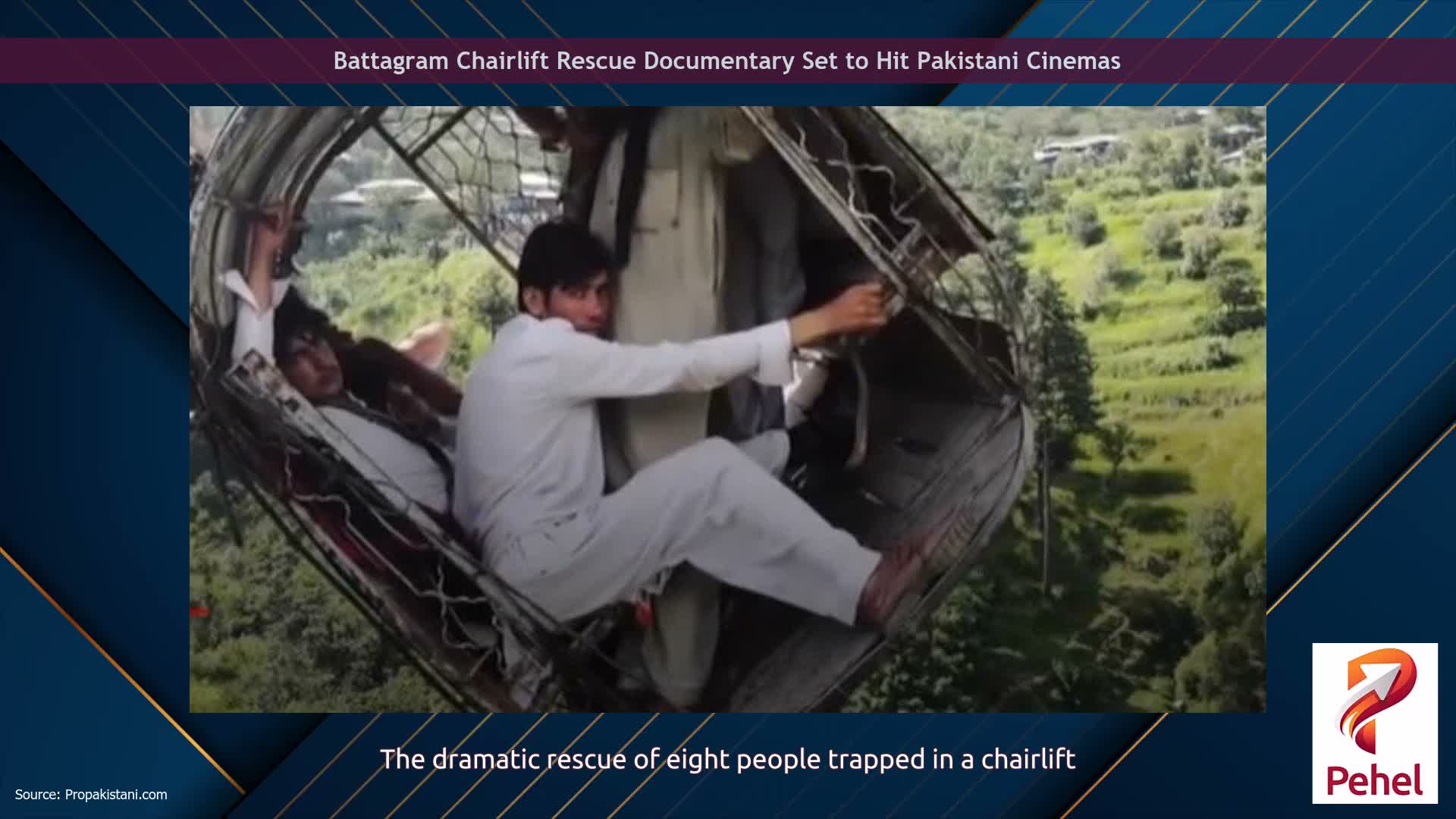
For 14 hours on August 22, 2023, everyone in Pakistan was anxiously glued to their TV screens as eight people — including six schoolchildren — were left dangling above a river in Khyber Pakhtunkhwa’s Battagram.
Now, filmmaker Mohammed Ali Naqvi is bringing the story of the daring rescue operation to the big screen with his documentary Hanging by a Wire. The film is set to screen across North America from August 28 and in the UK later this year.
Hanging by a Wire is produced jointly by teams from Pakistan, the US and the UK, with industry giant Universal Pictures Content Group being part of the process. The film has had a highly successful festival run, premiering on the first day of this year’s Sundance film festival and playing in Sydney, Seattle and at the Tribeca Festival in New York.
“To me, this film is a statement about what Pakistani cinema can be. A story from our mountains, told by our own people, can be a full-blooded action thriller — it can open Sundance, play the world’s biggest festivals, and be backed by a major Hollywood studio,” Naqvi said, according to a press release.
He said Pakistan’s stories didn’t “have to be small or solemn to matter” and that he hoped his film “opens doors for many more to come”.
The filmmaker is an industry veteran, having won an Emmy Television Academy Award in 2008 for his work on Shame . His directorial work includes Among the Believers, Pakistan’s Hidden Shame, and The Accused: Damned or Devoted?, both of which earned Emmy nods. He has also served as chair of Pakistan’s Academy Awards Selection Committee.
The film’s producer, Bilal Sami, has credits on David Blaine: Do Not Attempt, Laal Kabootar and Dobara Phir Se.
Hanging by a Wire follows the nearly-day-long rescue of eight passengers who were trapped in a cable car after two of its cables snapped — six of the passengers were boys on their way to school.
The rescue efforts, which the country watched on TV and social media with bated breath, initially involved helicopters and special forces operatives from the army and air force.
The helicopters were only able to retrieve two of the children by nightfall, after which bad weather and visibility forced them to return to base.
After that, rescuers retrieved the remaining passengers by sliding to the stranded cable car along one of the remaining cables and bringing its occupants back one-by-one late into the night.
The cable car, which crossed the Jhangri River, was the only way children in the area could cross the river in the absence of roads and bridges.
The assistant commissioner at the time said the cable car was run privately by locals and three other privately-operated cable car services were suspended in the aftermath of the incident for safety inspections.